


A trial balance is one of the most important tools used in accounting to check the mathematical accuracy of bookkeeping records. It provides a summarized list of ledger account balances at a specific date and helps accountants identify possible recording or posting mistakes. Although it does not guarantee that every transaction has been recorded correctly, it provides an essential foundation for preparing financial statements. Understanding how this accounting statement works can help students, business owners, and professionals better understand the financial health and accuracy of an organization.
| Quick Bio | Details |
|---|---|
| Keyword | Trial Balance |
| Category | Accounting |
| Main Purpose | Checking the arithmetical accuracy of ledger accounts |
| Prepared From | General ledger |
| Main Sections | Debit and credit columns |
| Common Uses | Error detection and financial statement preparation |
| Prepared By | Accountant or bookkeeper |
| Related Concepts | Ledger, journal, balance sheet, income statement |
Understanding the Basic Concept
The basic concept behind a trial balance is simple: every debit recorded in the accounting system should have an equal credit. Therefore, the total of all debit balances should normally match the total of all credit balances. Accountants prepare this statement after posting transactions to ledger accounts. If the two sides do not agree, there may be an error somewhere in the bookkeeping process. However, equal totals do not always mean that the accounting records are completely error-free.
Why It Matters in Accounting
A trial balance plays a valuable role in the accounting cycle because it provides a quick overview of ledger balances. Accountants can use it to review the results of bookkeeping before preparing financial statements. It also helps identify differences between debit and credit totals. For businesses, this process supports better financial control and makes the accounting system more reliable. Although modern accounting software performs many calculations automatically, the underlying accounting principle remains important for understanding how financial records are organized.
The Role of Double-Entry Bookkeeping
Double-entry bookkeeping is the foundation of the accounting system behind this statement. Under this method, every financial transaction affects at least two accounts. One account receives a debit entry, while another receives a corresponding credit entry. The amount recorded on both sides must be equal. This system creates a structured approach to recording financial activity. When ledger balances are collected together, accountants can compare the overall debit and credit totals to check whether the basic arithmetic relationship has been maintained.
Main Purpose of Preparation
The primary purpose of preparing a trial balance is to check the arithmetical accuracy of ledger postings. It allows accountants to compare the combined debit balances with the combined credit balances. If the totals differ, an investigation can begin to locate the problem. It also provides a convenient summary of account balances at a particular point in time. This information can then support the preparation of income statements, balance sheets, and other financial reports.
When It Is Usually Prepared
A trial balance may be prepared at different stages of the accounting cycle. Many businesses create one at the end of an accounting period, such as monthly, quarterly, or annually. Some organizations also prepare it whenever management needs to review account balances. Before financial statements are finalized, accountants commonly examine the unadjusted balances and then make necessary adjustments. After these adjustments, another version may be prepared to support the final reporting process.
Basic Format Explained
The traditional format includes two main columns: a debit column and a credit column. Each ledger account is listed with its corresponding balance in the appropriate column. Asset and expense accounts commonly carry debit balances, while liabilities, equity, and revenue accounts commonly carry credit balances. The final row contains the total of both columns. Ideally, the two totals should be equal. A difference indicates that further investigation is necessary.
Important Accounts Included
The accounts included depend on the organization’s bookkeeping records. Common examples include cash, bank, accounts receivable, inventory, equipment, accounts payable, loans, capital, sales revenue, purchases, wages, rent, utilities, and other expenses. Each account is taken from the general ledger and placed into the appropriate column based on its closing balance. The resulting list provides a condensed view of the accounts that have been affected during the relevant period.
Steps Involved in Preparation
Preparing a trial balance involves several organized steps. First, transactions are recorded in journals. Next, the entries are posted to individual ledger accounts. After posting is complete, each ledger account is balanced to determine its closing amount. The accountant then lists the accounts and places their balances into debit or credit columns. Finally, both columns are totaled and compared. If they agree, the basic arithmetic relationship appears correct; if not, the records require further examination.
The Importance of Ledger Accounts
Ledger accounts are essential because they provide the detailed information used to create the summary statement. While journals record transactions chronologically, ledgers organize them by account. For example, all cash-related entries are collected in the cash account. The closing balance of each ledger account is then used in the summary. Accurate ledger maintenance is therefore critical. If ledger postings are incomplete or incorrect, the resulting accounting report may also contain inaccuracies.
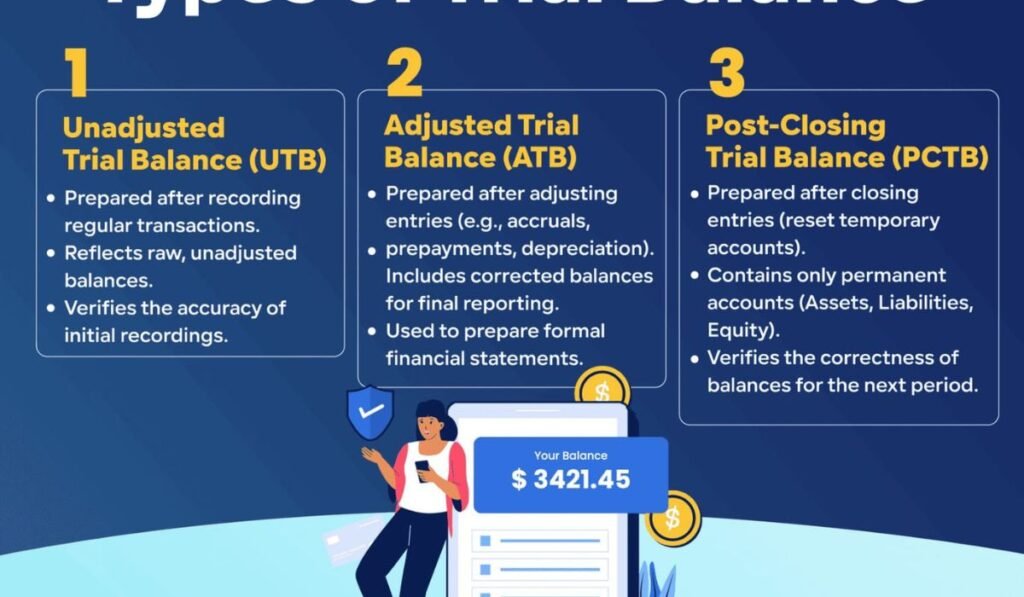
Unadjusted Version
An unadjusted trial balance is prepared before accountants make adjusting entries. It represents the balances that exist in the ledger at that stage of the accounting cycle. These balances may not yet reflect certain accrued expenses, prepaid items, depreciation, or other necessary adjustments. Accountants use this version as a starting point for reviewing the records. After identifying adjustments, they update the relevant accounts and prepare an adjusted version for financial reporting.
Adjusted Version
An adjusted trial balance is created after required adjusting entries have been posted. These adjustments may include accrued income, accrued expenses, depreciation, prepaid expenses, and other accounting corrections. The adjusted version provides more accurate account balances for preparing financial statements. It is especially useful because it brings certain transactions and events into the correct accounting period. This supports the matching principle and helps businesses present a more realistic picture of their financial performance.
Post-Closing Version
A post-closing trial balance is prepared after temporary accounts have been closed at the end of an accounting period. Revenue and expense accounts are transferred to the appropriate equity or retained earnings account, leaving permanent accounts open for the next period. The post-closing statement generally contains assets, liabilities, and equity accounts. Its main purpose is to verify that the ledger remains mathematically balanced after closing entries have been completed.
Common Types Explained
There are several types of trial balances used during the accounting cycle. The most common are the unadjusted, adjusted, and post-closing versions. Each serves a different purpose and is prepared at a different stage. The unadjusted version summarizes initial ledger balances, the adjusted version reflects necessary corrections and adjustments, and the post-closing version confirms balances after temporary accounts have been closed. Understanding these variations makes the overall accounting process easier to follow.
Errors That Can Be Detected
A trial balance can help identify certain bookkeeping errors. For example, if a debit entry is posted without its corresponding credit, the totals may not agree. Similarly, an incorrect addition of a ledger account or an amount entered on only one side can create a difference. Transposition and some calculation mistakes may also become visible. Accountants can compare totals and review individual entries to locate discrepancies before financial statements are prepared.
Errors That May Remain Hidden
An important limitation is that equal debit and credit totals do not prove that every accounting entry is correct. Some mistakes affect both sides equally and therefore remain undetected. For example, a transaction could be posted to the wrong account while maintaining equal debit and credit amounts. An entire transaction could also be omitted. Errors of principle and compensating errors may similarly escape detection. Therefore, additional review procedures are always necessary.
Error of Complete Omission
An error of complete omission happens when a transaction is not recorded anywhere in the accounting system. Because neither a debit nor a credit is entered, the totals can still agree. For example, if a business purchases office supplies but completely forgets to record the transaction, the summary will not reveal the omission. This demonstrates why equal totals should not be interpreted as absolute proof of accounting accuracy.
Error of Principle
An error of principle occurs when a transaction is recorded in an incorrect category of account. For example, purchasing a long-term asset might mistakenly be recorded as an ordinary expense. The debit and credit amounts can still be equal, meaning the accounting statement may balance. However, the financial statements could be materially affected because the transaction has been classified incorrectly. Careful account classification is therefore essential for reliable reporting.
Compensating Errors
Compensating errors occur when two or more mistakes offset one another. Imagine that one account is understated by a particular amount while another account is overstated by the same amount. The overall debit and credit totals may still match despite the presence of errors. These mistakes can be difficult to discover through a basic comparison alone. Detailed account reviews, reconciliations, and supporting documentation are often needed to identify such problems.
Transposition and Slide Errors
Transposition errors happen when digits are accidentally reversed. For example, an amount such as 5,240 might be entered as 5,420. Slide errors involve moving a decimal point or placing digits incorrectly. Depending on where the mistake occurs, the difference between the debit and credit totals may provide clues. Accountants sometimes analyze the difference mathematically to identify possible data-entry mistakes. Modern accounting software can reduce these errors, but manual review remains valuable.
Relationship With Financial Statements
The information in a trial balance supports the preparation of key financial statements. Once accounts have been adjusted, their balances can be used to prepare an income statement and balance sheet. Revenue and expense accounts contribute to the calculation of profit or loss, while assets, liabilities, and equity accounts help construct the statement of financial position. As a result, accurate ledger balances are an important foundation for meaningful financial reporting.
Difference Between a Trial Balance and Balance Sheet
A trial balance and a balance sheet serve different purposes. The former is primarily an internal accounting tool used to summarize ledger balances and check arithmetical accuracy. A balance sheet, on the other hand, is a formal financial statement that presents assets, liabilities, and equity at a specific date. The balance sheet follows a structured reporting format and is designed to communicate financial position to stakeholders. It is prepared using information from the accounting records.
Difference Between a Trial Balance and General Ledger
The general ledger contains detailed records for individual accounts, while a trial balance summarizes the closing balances of those accounts. Think of the ledger as a detailed collection of individual financial records and the summary as a snapshot of their final balances. Accountants use ledger information to prepare the summary. Therefore, the two are closely connected, but they are not interchangeable. One provides detail, while the other offers a condensed overview.
Difference Between Trial Balance and Balance Verification
Balance verification involves checking whether accounting records are internally consistent. A trial balance provides one method of performing this check by comparing total debits and credits. However, broader verification may involve bank reconciliations, invoice matching, inventory counts, and reviewing source documents. These procedures provide stronger assurance that transactions have been recorded accurately. Businesses should therefore use the statement as one part of a wider internal control system.
Role of Accounting Software
Modern accounting software has made the preparation of trial balances faster and more efficient. Many programs automatically calculate account balances and generate reports with a few clicks. When users enter transactions correctly, the software automatically applies double-entry principles. This reduces many manual calculation errors. However, software cannot always detect incorrect account classifications, omitted transactions, or fraudulent entries. Human judgment and proper financial controls remain essential even in highly automated accounting environments.
Benefits for Small Businesses
Small businesses can benefit greatly from regularly reviewing their accounting records. A trial balance helps owners and bookkeepers identify discrepancies before they become larger problems. It can also provide a useful overview of financial activity and support tax preparation and financial reporting. Regular reviews may help businesses maintain cleaner records and improve decision-making. Even businesses using accounting software should understand the basic principles behind the reports they generate.
Benefits for Large Organizations
Large organizations often manage thousands of transactions across multiple departments and locations. A trial balance helps accounting teams consolidate information and monitor account balances. It can support monthly closing procedures, internal audits, and financial reporting. In larger organizations, automated systems may generate detailed reports that accountants review for unusual changes or inconsistencies. This structured approach can improve efficiency and provide management with greater confidence in the accuracy of financial information.
Importance for Students
Learning about the trial balance is essential for accounting students because it connects several fundamental concepts. Students can see how journal entries move into ledger accounts and eventually become part of financial statements. It also helps them understand debit and credit rules and the accounting cycle. By practicing preparation and error correction, learners develop analytical skills that are useful in bookkeeping, auditing, finance, and business management.
Practical Example
Suppose a business has cash of $10,000, equipment worth $5,000, accounts payable of $3,000, owner equity of $9,000, and revenue and expense balances that complete the accounting records. Each account is placed into the appropriate debit or credit column according to its balance. After all accounts are listed, the columns are totaled. If the totals match, the basic double-entry relationship has been maintained. If they differ, the accountant investigates the records.
How to Find Differences
When the debit and credit totals do not agree, accountants generally begin by checking the arithmetic. They may recalculate the column totals and verify that every ledger account has been included. Next, they compare individual balances with the ledger and review recent journal entries. They may also check whether an amount was entered in the wrong column. A systematic approach helps narrow down the source of the discrepancy and reduces the time required for correction.
How Reconciliation Helps
Reconciliation is an important accounting procedure that complements the trial balance. Bank reconciliation, for instance, compares internal cash records with bank statements. Differences may result from outstanding checks, deposits in transit, bank fees, or errors. Other reconciliations can compare customer balances, supplier accounts, and inventory records with supporting documentation. These procedures help uncover issues that a simple debit-and-credit comparison may not detect.
Internal Controls and Accuracy
Strong internal controls improve the reliability of accounting information. Businesses can establish approval procedures, segregation of duties, access restrictions, regular reconciliations, and review processes. These controls reduce the likelihood of errors and unauthorized transactions. A trial balance can then serve as one checkpoint within the broader control environment. When combined with proper documentation and independent review, it contributes to a more dependable accounting system.
Importance During Audits
Auditors may review trial balances as part of their examination of financial records. The statement can help auditors understand account balances and identify areas requiring further investigation. However, auditors do not rely on it alone. They may examine invoices, contracts, bank statements, confirmations, and other evidence. The summary provides a useful starting point for understanding the accounting records, while audit procedures provide deeper assurance regarding financial reporting.
Common Mistakes in Preparation
Several mistakes can occur while preparing a trial balance. These include leaving out an account, entering a balance in the wrong column, copying an incorrect amount, or adding columns incorrectly. Another common problem is using outdated ledger balances after adjustments have been posted. Maintaining organized records and following a consistent process can minimize these issues. Accounting software also helps automate calculations and reduce manual errors.
Best Practices for Businesses
Businesses should prepare and review accounting reports regularly rather than waiting until year-end. Keeping ledgers updated, reconciling important accounts, maintaining supporting documents, and reviewing unusual balances can improve accuracy. It is also helpful to establish clear closing procedures and assign responsibility to qualified personnel. Regular reviews allow errors to be identified earlier, making corrections easier and reducing the risk of inaccurate financial reporting.
Limitations of the Process
Although a trial balance is useful, it has important limitations. It primarily checks the equality of debit and credit totals rather than proving that every transaction is accurate. It cannot necessarily detect omitted transactions, incorrect account classifications, or certain fraud schemes. It also does not replace financial statement analysis or independent auditing. Understanding these limitations prevents users from placing too much confidence in a single accounting check.
Connection With the Accounting Cycle
The accounting cycle is a series of steps used to process financial transactions. It generally begins with identifying transactions and recording them in journals. Entries are then posted to ledgers, balances are summarized, adjustments are made, and financial statements are prepared. The trial balance appears at important stages of this process. Understanding its position within the cycle helps explain why it is such an important bridge between bookkeeping and financial reporting.
How Technology Is Changing Accounting
Technology continues to transform accounting practices. Cloud-based platforms, automated reconciliations, artificial intelligence, and integrated financial systems are reducing manual work. These technologies can generate real-time reports and identify unusual patterns more quickly. However, technology does not eliminate the need for accounting knowledge. Professionals still need to understand financial principles, evaluate unusual transactions, and interpret results. The future of accounting will likely combine automation with human judgment and professional oversight.
Importance for Financial Decision-Making
Accurate accounting information supports better business decisions. Managers may use financial reports to evaluate expenses, monitor revenue, control cash flow, and plan future investments. The trial balance itself is not usually a final decision-making report, but it contributes to the accurate financial statements managers rely upon. When the underlying accounting records are reliable, decision-makers can work with greater confidence and reduce the risk of basing important choices on incorrect information.
Frequently Asked Questions
1. What is the main purpose of a trial balance?
- Answer: Its main purpose is to summarize ledger account balances and check whether total debit balances equal total credit balances.
2. Does a balanced trial balance mean there are no errors?
- Answer: No. Some errors, including complete omissions and incorrect account classifications, may still exist even when both sides are equal.
3. What are the main types of trial balances?
- Answer: The main types are unadjusted, adjusted, and post-closing versions, each prepared at a different stage of the accounting cycle.
4. What happens if the debit and credit totals do not match?
- Answer: Accountants investigate the records by checking calculations, ledger balances, journal entries, and account postings to locate the difference.
5. Is a trial balance the same as a balance sheet?
- Answer: No. A trial balance is an internal accounting summary, while a balance sheet is a formal financial statement showing assets, liabilities, and equity.
Final Thoughts
A trial balance remains a fundamental part of accounting because it connects detailed bookkeeping records with financial reporting. It provides a structured way to summarize ledger balances, identify certain errors, and support the preparation of financial statements. However, it should never be treated as absolute proof that financial records are completely accurate. Businesses and accounting professionals should combine it with reconciliations, internal controls, source-document reviews, and other verification procedures. For additional background on accounting concepts and related financial terminology, readers can explore the relevant Wikipedia accounting resources.
